Dauntless Circus

Dauntless Circus

“The history of the circus is a history of powerful stories, risk taking, spectacle and eroticism, successes and setbacks, of big heroes and special families.”
Jacobs M., Circus in Flanders, Brussel, Ministry of the Flemish Community, 2002, quote adopted from ‘In de ban van de ring: Beeld en betekenis van het circus in de burgerlijke samenleving (1850-1950)’, research paper by Sarah Keymeulen, written in 2003-2004

What is the place of a festival, what is its purpose, but also its physical meaning, where does it fit, where does it belong, where is it held, what is its structure and appearance and why is it like that?

The contemporary music festival as an entity is in decline, each year numerous reports of festivals going bankrupt make it into the news, with 172 festivals having disappeared between 2019 and 2024 in the UK alone, 37 more in 2025, as stated by Five Percent For Festivals, and the numbers keep dwindling globally. A reflection of the economic recession we are currently in, for sure, young people are now much poorer than their parents were in their time, having to choose between going on vacation or visit a large festival, let alone multiple in one summer.

In the city of Antwerp, continued gentrification has seen iconic club spaces such as Petrol and squatted cultural house Scheld’Apen disappear. While clubs and dance café’s in the city center have had to shut doors due to newly moved complaining neighbours’ voices having much more weight than they should. Although credit can be given to the municipality for allowing the re-use of legendary house club Café d’Anvers, under new ownership and new name Traum, located in Antwerp’s red light district, as well as permitting the appearance of the new 3000 capacity venue Garage Klub, a little outside of the city. Both are struggling to maintain strong numbers each weekend.

Festivals too have been pushed way outside of the city’s borders. The once celebrated Laundry Day, a street festival that originated in the Kammenstraat, smack in the middle of the city, was consistently moved away from the center, until it was no longer welcome. Today it no longer exists. The same for Vaag Outdoor more recently, when it was no longer allowed a permit to welcome its 6000 visitors on Spoor Oost, an appointed event area east of the city where the Sinksenfoor (carnival) resides, which was also moved from its historic South location in 2015 after 44 consecutive years, because of the complaints of only six neighbours.

While smaller festivals like Klub Dramatik and Transit are being told by city officials that controls on sound and environment are being increased each year, forcing them to already study the city map for an alternative space, which is non-existent. Combined with the rising costs of logistics and materials, smaller scale festivals are in complete survival mode, turning and twisting every cent just to stay above water, in the hopes their venue sells out and for the sun to shine so visitors consume enough beverages, just to reach a break even point. And it’s the same with Doel Festival. A sad truth that is not always visible, nor fun to talk about.

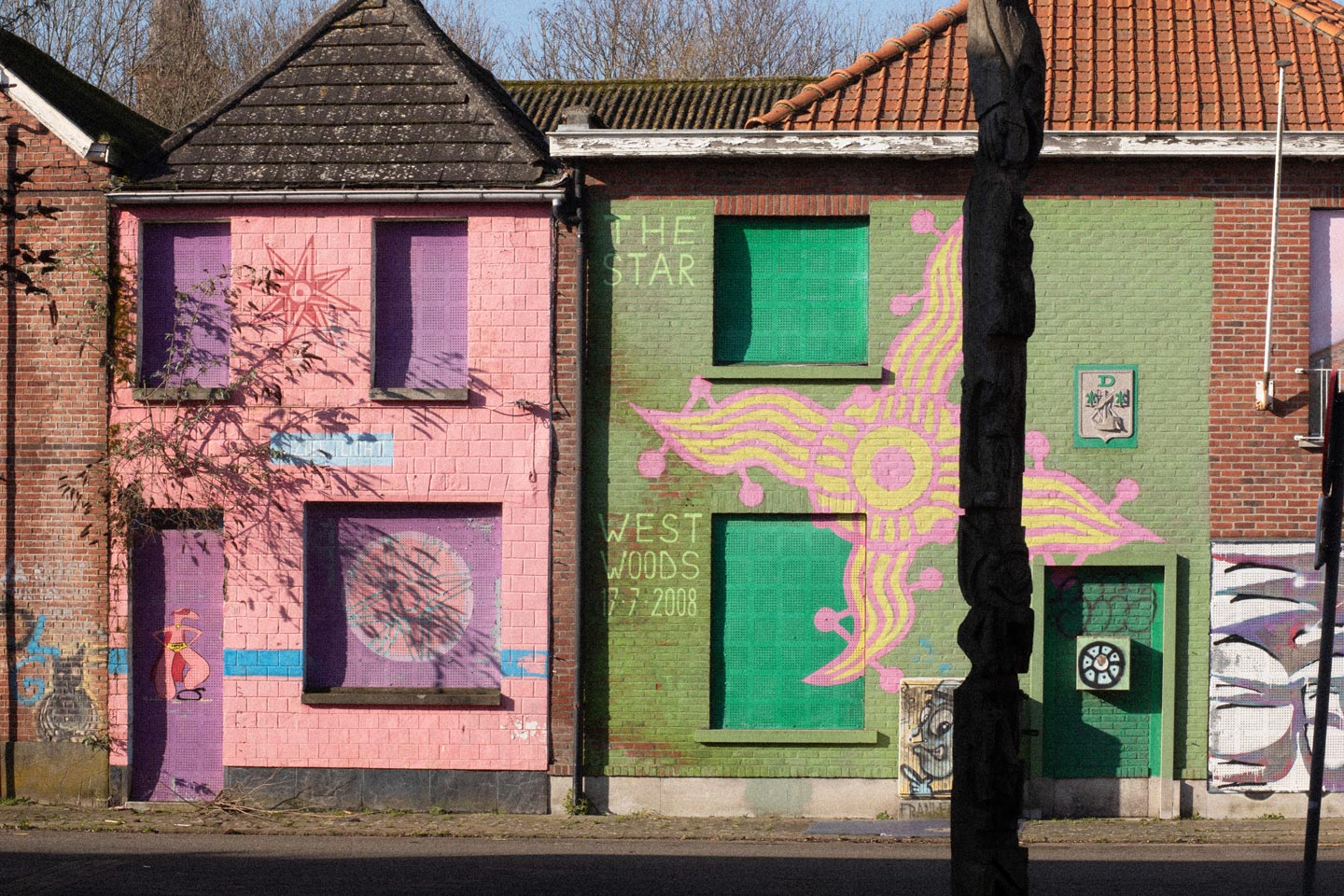
When Doel Festival started in 2022, the town had only just won their longstanding battle for remainder and with that the beginning of a process of “what to do with Doel?” on a political level. Here also, gentrification has crept in, with the first houses being renovated and plans for rebuilding parts of its open areas into public walking space and gardens. As more houses become inhabited, what will happen to the festival which is now at its fourth edition and can be considered a part of Doel? Will it suffer a similar fate as Laundry Day or will the festival be embraced into complete symbiosis with the town, like the Gentse Feesten or the Carnival of Aalst, where inhabitants are an active part of the festivities, which is already the case now with Doel Festival.

Doel clearly has multiple future paths, to be inhabited fully, but also to attract more cultural players, Herita for instance, who are renovating the protected Hooghuis building, are willing to research the possibility of opening an artist residency. Atelier De Nys, which is still used as a studio and event space bij VZW De Maakschappij and ongoing research studies by KU Leuven’s department of architecture continue to imagine activated spaces for Doel and even build them, like the field lab and watch tower near the Hooghuis. In Doel lies a very rare opportunity to let culture thrive independently, exactly because of its emptiness. The ones in need of cheap space have always been the artists. Everything else comes after.

“I have no past, and an excess of future.”
Martin Adân, poet, quote adopted from the book ‘Shadow Cities: A Billion Squatters, A New Urban World’ by Robert Neuwirth, written in 2004.

Doel has been abandoned almost fully and brought to a unique state because of it. There is space to work here and people are already attracted to its many visual layers which the town has gathered only because time has gone forward, as proven by the many day tourists that pass by during the weekend. Some of those layers are the proof of difficult and darker times, houses being illegally stripped empty all the way to the copper wiring, which necessitated metal plating to cover all doors and windows, and each vagrant wall getting decked out in weekly fresh additions of graffiti, but conversing with its few current inhabitants, they show a clear love for a place that is both beautiful and rough. In those 20 plus years of limbo, Doel has been shaped anew. There is value in that. To gentrify it completely would be a shame. To remove its layers of history, a sin. Let parts of Doel speak, let it tell its story, though culture, through heritage. Through music and art.

According to Foucault, the modern Western city is one of orderly fashion and strategic planning to maintain control and regulation, its inhabitants subjected to social disciplines and government inspection, also a city’s peripheries and thus those that live in the margin. During his time, the circus and its artists were considered to have their place within that margin and were pushed more and more outside the city’s center. To be sentenced to the outskirts, so was the fate of the circus. Yet this placement in society was also its appeal, to be the voice of the quirky, the representation of the exciting, the visualisation of the magical, a mischievous spectacle in breach with the daily order.

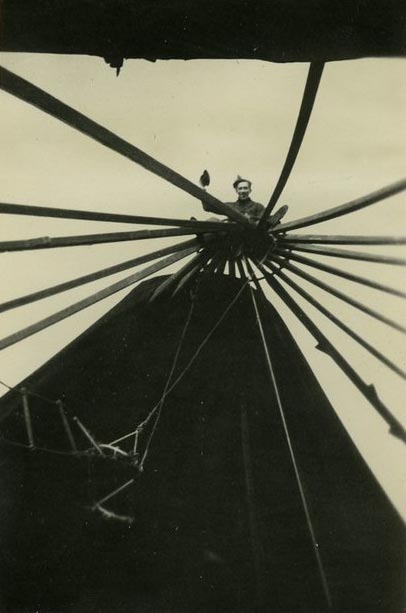
Circus companies prefer to come and go and build interim structures, without leaving any impressions in the landscape they occupy. Amidst an urbanised environment, the circus kept representing the irrational urge to forever be nomadic. They are the symbol of temporality and transience, constantly reforming, reinventing, in part due to their economic vulnerability.

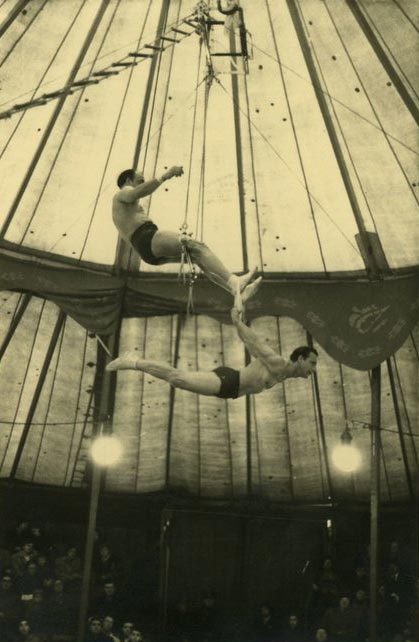
During a show, the artists perform seemingly improvised acts, one after the other in fast succession. Bright and bold, with margin for actual failure, surely dependent on a dose of luck. Then and there, they give the spectator the illusion of time bending outward, coming to a complete standstill at air gasping moments. Therein lies the attraction of the circus.

Nevertheless, due to their societal standing and difficulty to maintain a steady income, circus companies, more often circus families of multiple generations, became an absolute rarity, with just eight active travelling companies left in Belgium, according to Circus in Flanders. In an interview with Newsmonkey in 2019, Stefan Vranckx of Circus Barones said that it is increasingly harder to make a profit. “Bigger cities like Hasselt let us stay completely for free, they see the value in a circus for the city, but in Antwerp they doubled stand fees, for the city it’s a source of income. For us it’s a big problem.”

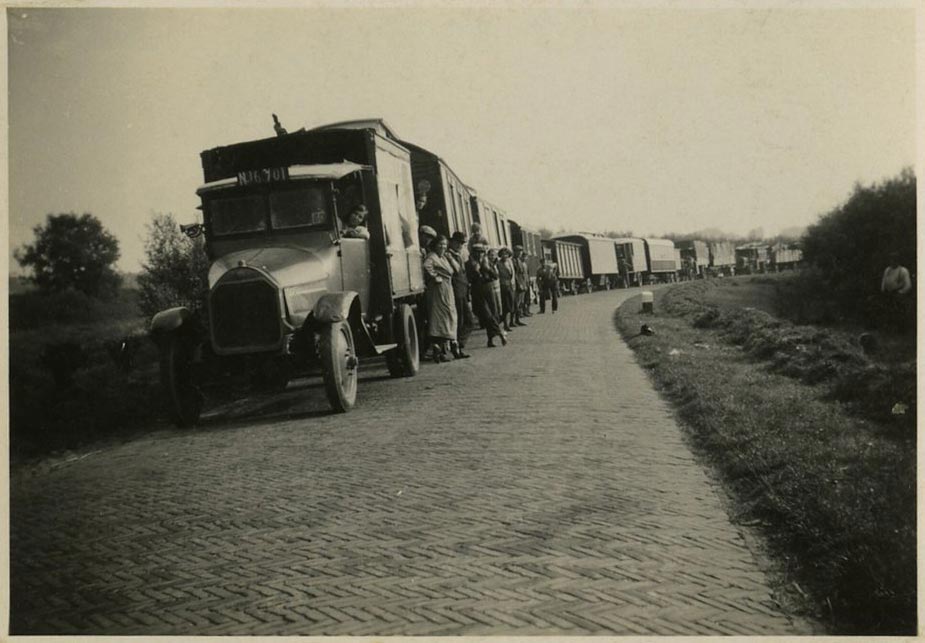
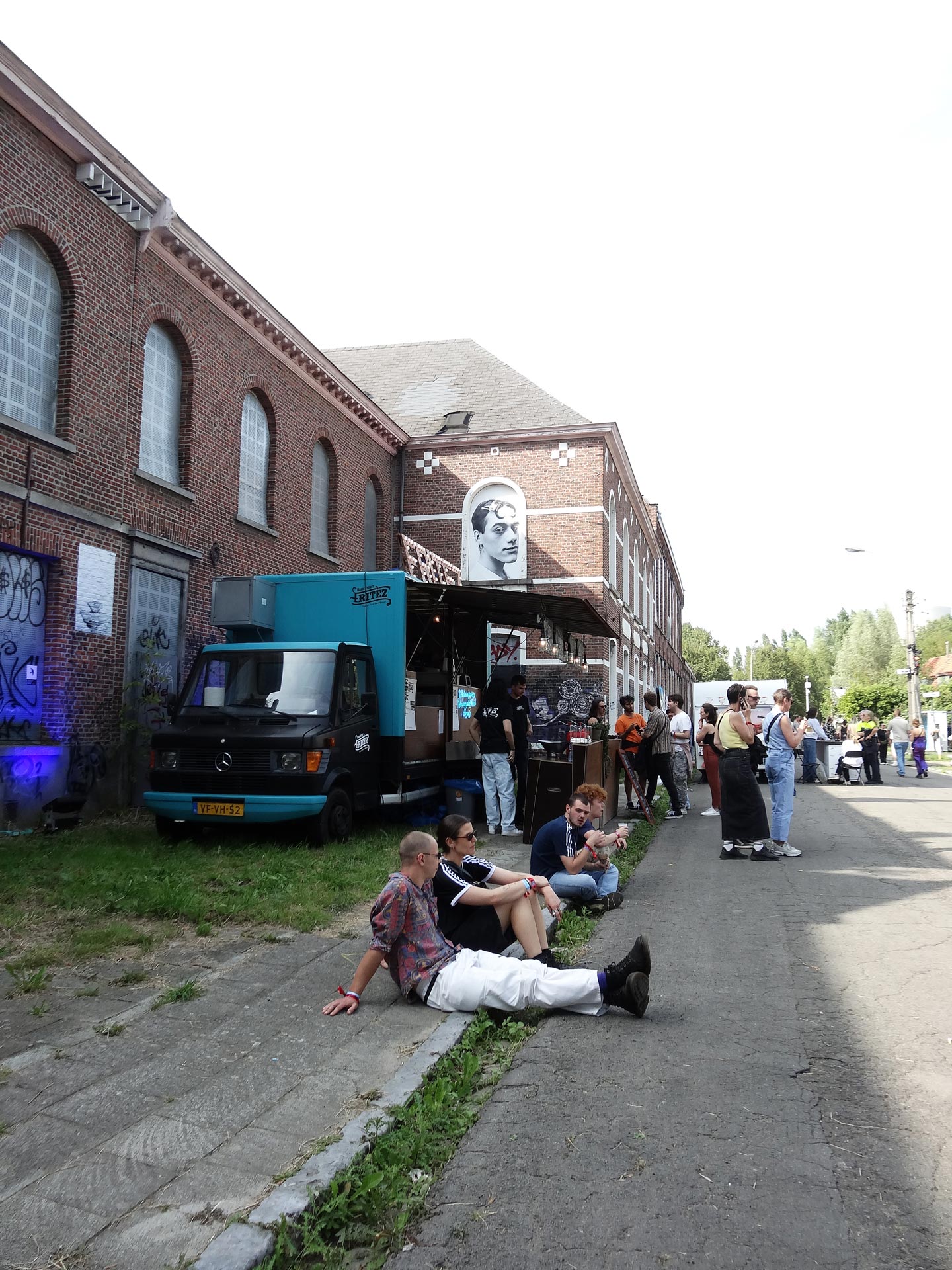
The similarities are becoming visible. Both the festival and circus are of a temporary character, placing safe but barebones structures that need to be built up and tore down in a matter of weeks, sometimes days, in functional and at the same time enticing shapes. Attempting to attract local visitors and beyond, luring the crowd with bright and folkish marketing campaigns that play on our sense of joy, vibrant posters, colourful pictures of entertainers and happy faces. Most profoundly, both provide otherworldly visual and auditory experiences where time is not of the importance, where one can loose themselves to the spectacle and let go of the grind that is basic life in the modern Western age. Although less and less welcome within a city’s boundaries.


Is the history of the circus a foreboding for the future of the festival? Is the festival valued enough, even in economic hardship, or will it be gradually pushed out and away from the people? Can we find a sustainable solution for the smaller ones or will there in the future only remain eight big ones?

So much like the circus, the festival may be on the chopping board. A festivity so ingrained in our culture to be shunned and pushed out, while at the same time a getaway, offering necessary escapism. We have danced throughout history, we have entertained ourselves before doing politics. We need people’s gatherings to push us through daily life and we need the space to gather. And we need to continue to claim that space. If there’s no room, then make it.

The exhibition Dauntless Circus is a celebration. A celebration of folk and party culture, a celebration of the abnormal, and of course a celebration of the arts. It’s also a rebellion. Through celebrating it sends a message. It says: “We are present, alive, kicking, bold and beautifully. Loud and clear.”, surviving each and every salto mortale.

Alexandre Bavard

The multidisciplinary work of Alexandre Bavard explores the intersections of sociology, history, and anthropology. With a background in graffiti art, his practice is charged with socio-ecological and urban interventions that address issues such as overconsumption and the marginalisation of communities. He questions the place of the individual in the modern urban environment, using iconography and visual language drawn from his Georgian roots. The result are immersive installations, fully formed universes where sculpture and performance converge, in which identity is obscured, and values and norms are restructured. Bavard approaches this with a strong sense of both individual and collective protest against the establishment.

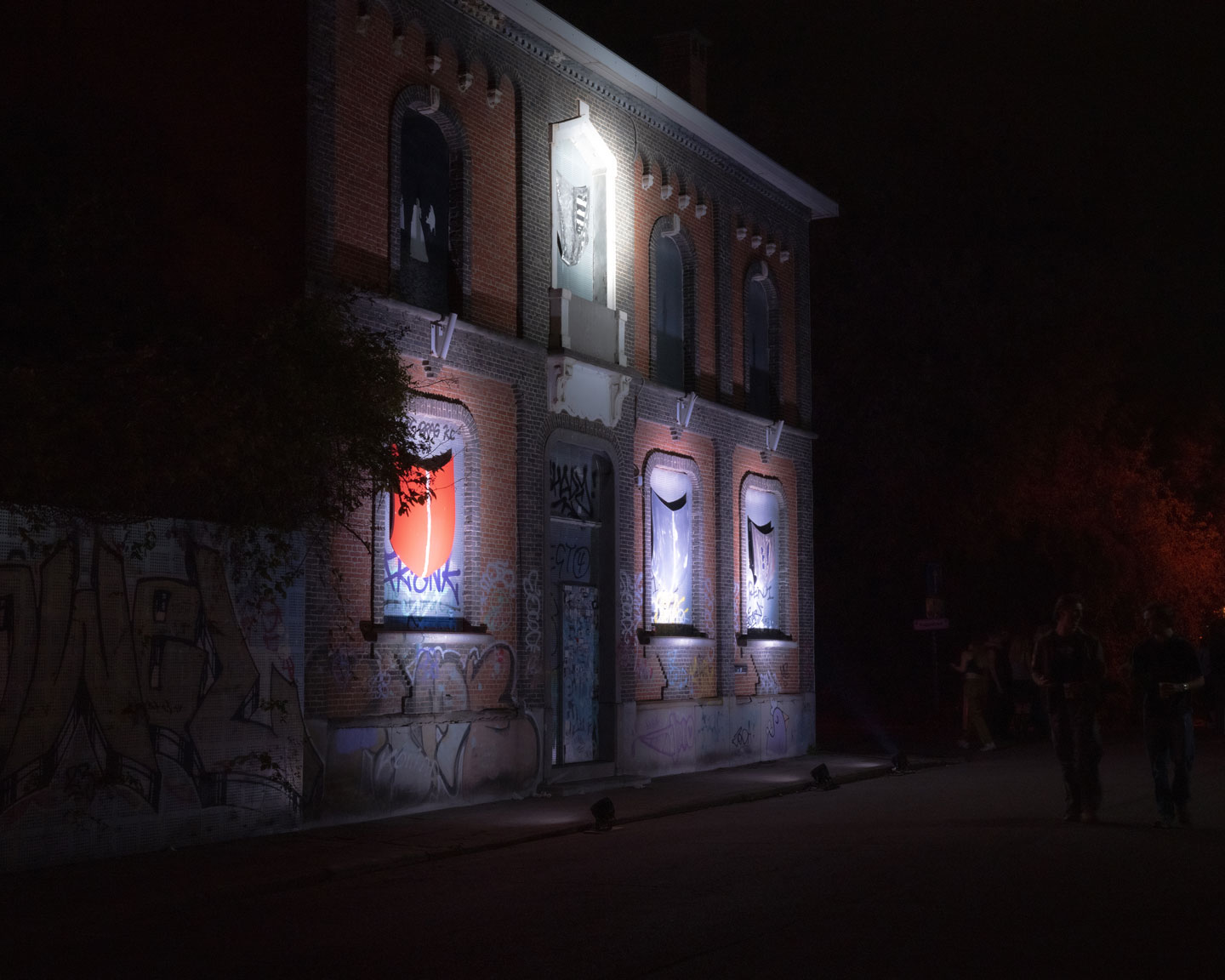
At Doel Festival, Bavard presented ‘Corridor’. A gateway, a large-scale central installation in the main street of the festival grounds. A new production, created specifically for Doel Festival, feature a multimedia scenography into a scaffold structure, where each visitor was forced to pass through a transformative experience which segments parts of the festival. The installation was extra activated with a dance performance by Maeva Berthelot.

Fleur De Roeck

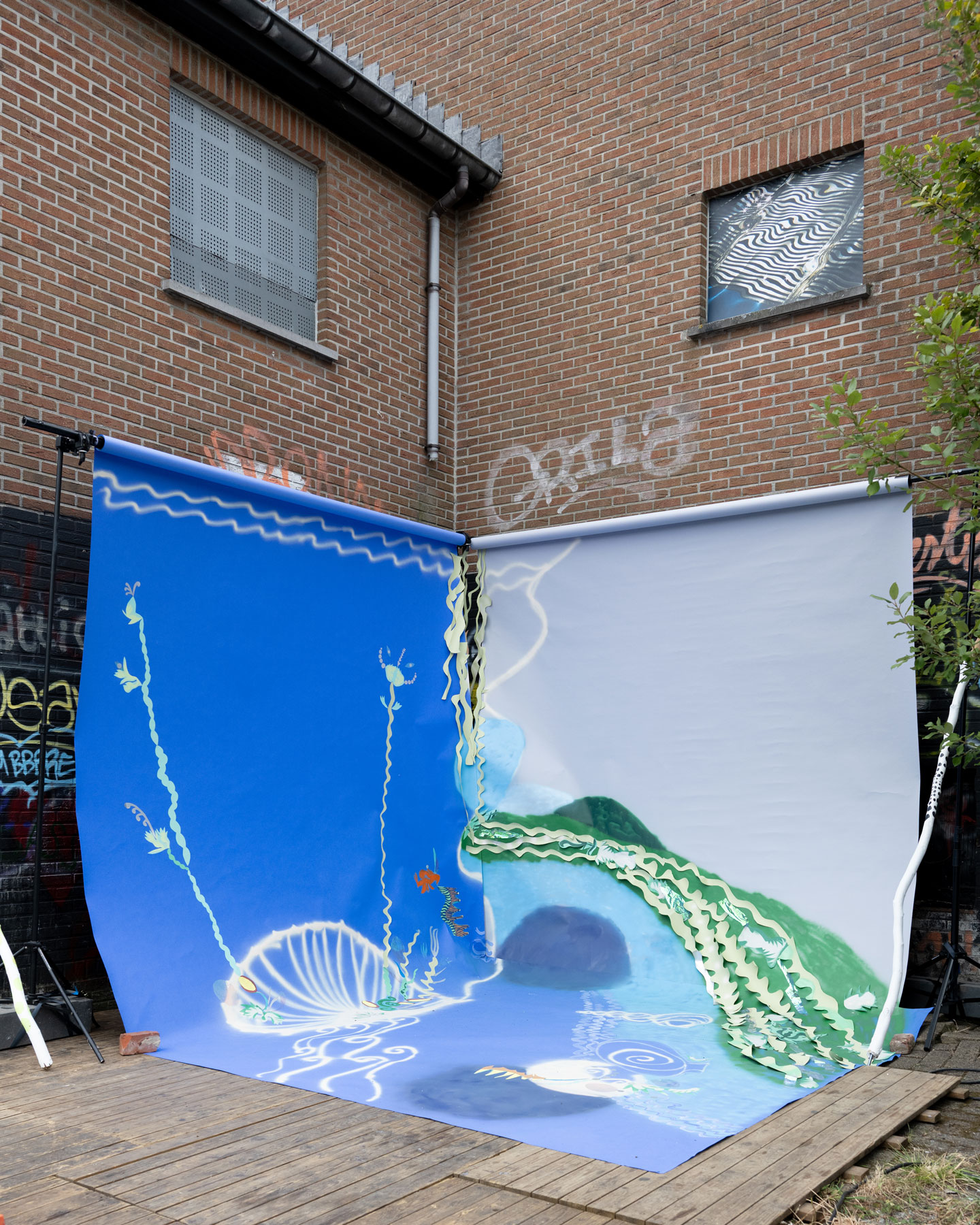
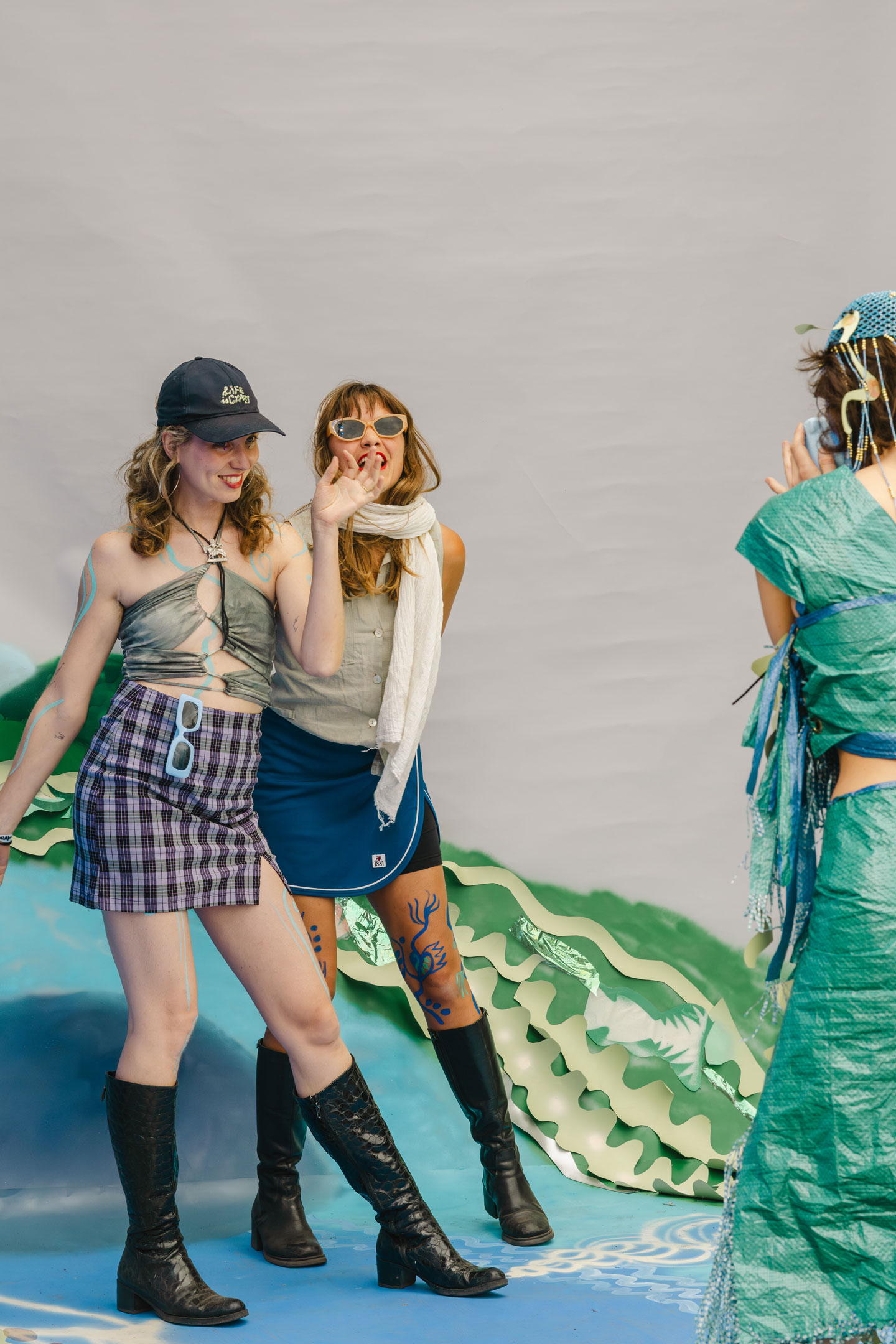
Fleur De Roeck is first and foremost a painter, but she has expanded her practice into a world where singing, spoken word, performance, and photography come together, all expressed through a distinctive visual language. She constructs elaborate mise-en-scènes in which she herself performs, while also inviting other artists to dive into their shared fantasies. This process becomes a way for her to connect with others, to collectively explore the beings they aspire to be. She uses canvas, paper, paint, and also discarded materials to create colourful panels, costumes, drapery, and face and body painting. Their imaginative, playful world thus becomes visible. De Roeck then takes Polaroid portraits of her performers, documents of the performance, remnants of the work, memories of a fantasy.

At Doel Festival, Fleur set up a photo corner in the village, where she and two colleagues performed in an evolving spectacle that changes throughout the day. Visitors will be invited to participate, to bring out their inner selves, to be face painted. De Roeck will take two Polaroids of each participant: one to give as a keepsake, and one to keep as an archival piece.

Ayrton Eblé

Ayrton Eblé’s work explores transitional phases in urban public space, places under construction, in a state of flux, unfinished and raw, and our interactions with them. At the heart of his practice lies the question of ownership over these sites, and the boundaries that are imposed around them. Through unofficial installations and unannounced interventions or happenings, he investigates how these boundaries can be blurred and control can be subverted. His actions may resemble acts of vandalism, but are primarily rebellious gestures that reclaim forgotten spaces until they are reactivated.

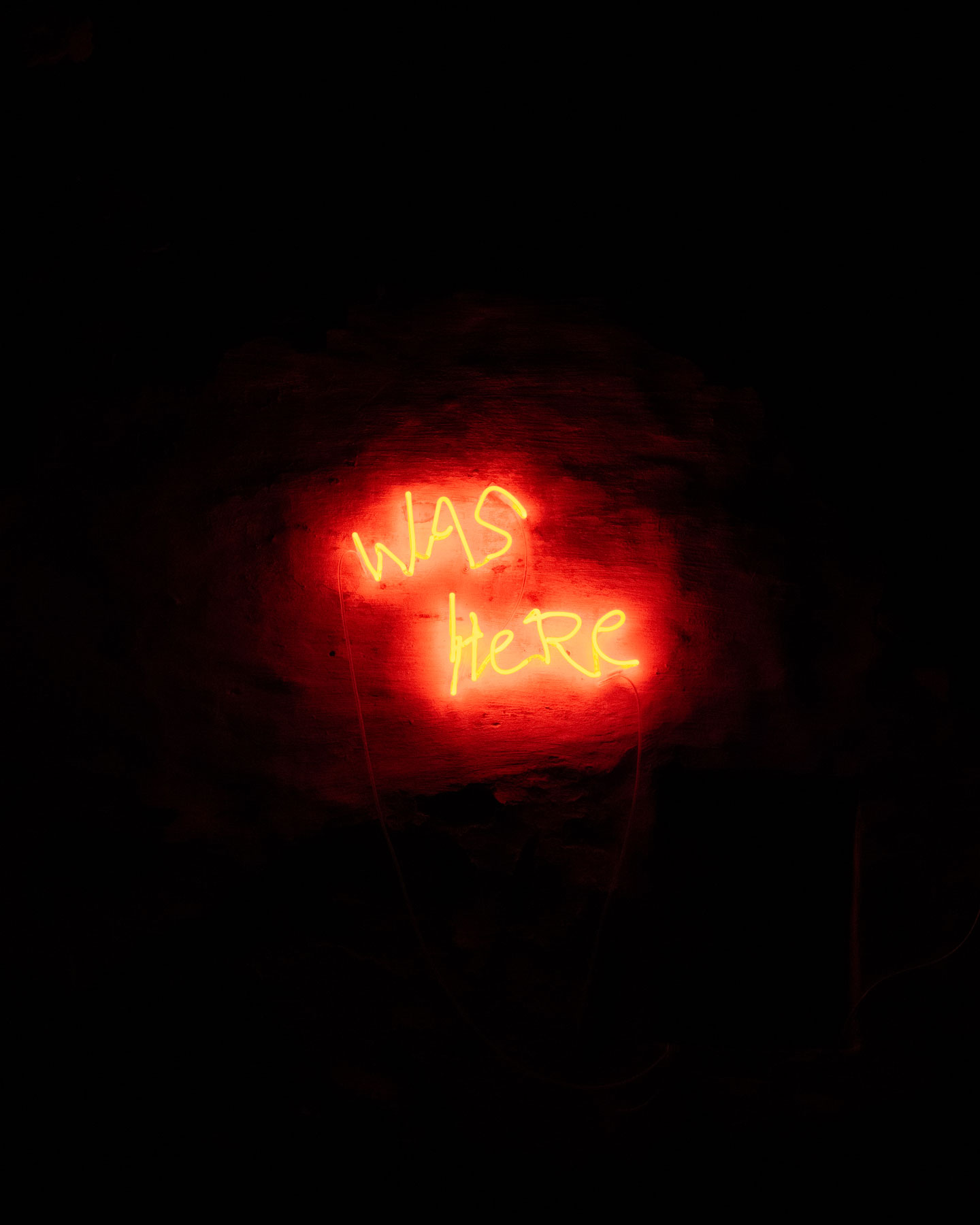
The neon installation ‘… was here’ is permanently installed on the facade of the art collective Tarmac in Meermout. It was placed on the side of the building where a house used to stand, pressed directly against the wall, the traces of which are still clearly visible. For Doel Festival, we invited Eblé to create a second version of this existing work, to be installed in Doel. Resonating poignantly with the village’s history, its former residents, and the buildings that were illegally demolished. 

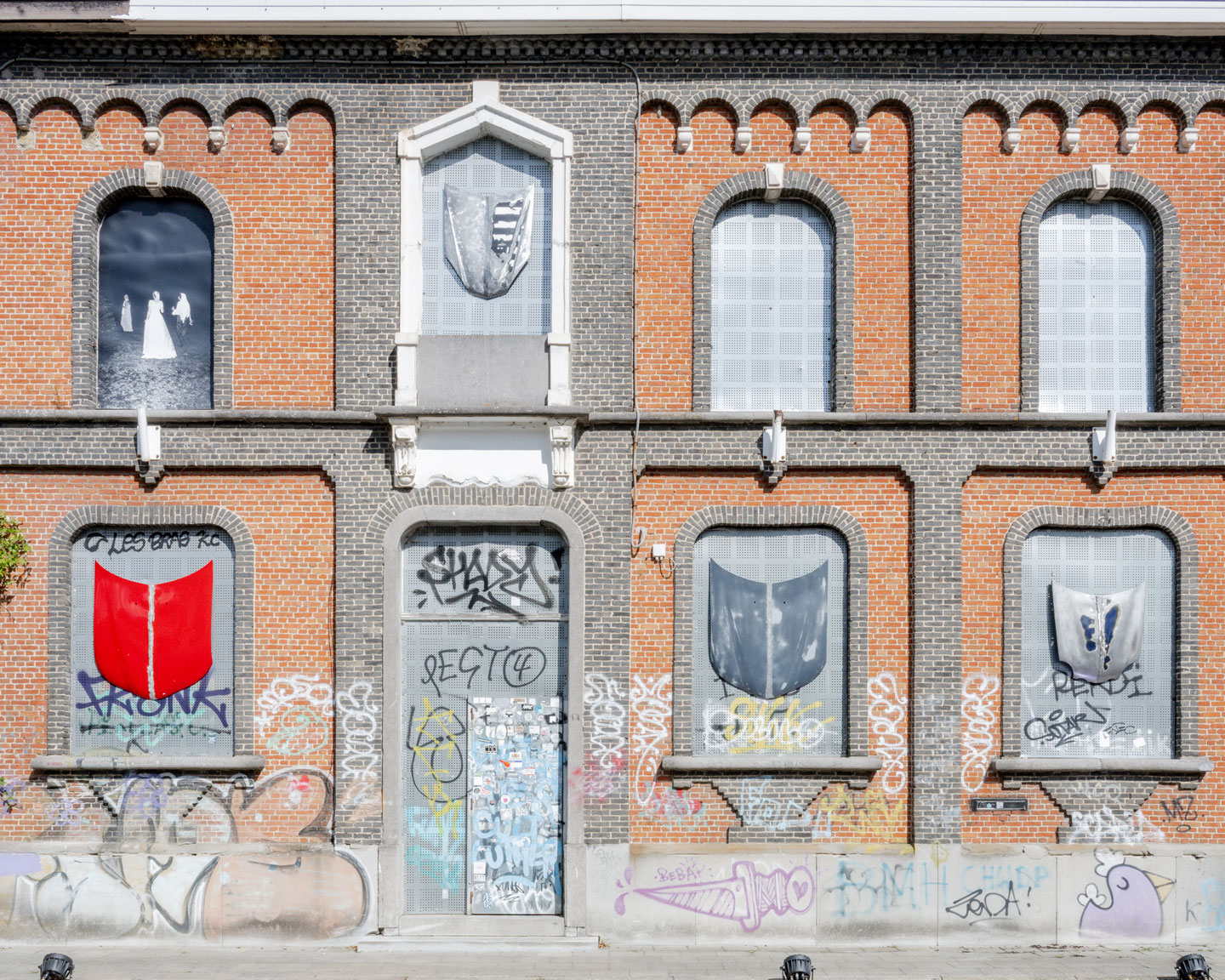
In addition, Eblé will presented a series of metal coats of arms, made from repurposed car hoods, hung on the facade of the old City Hall of Doel. These refer to tuning and car culture, expressions of personal identity, highly visible in Doel due to the weekly visits of car and tuning enthusiasts who use the village as a meeting spot and as a backdrop for photographing their vehicles. The coats of arms can also be seen as symbols of Doel as a final frontier, a bastion held up by activist groups and squatter communities.

Joost Pauwaert

When confronted with Pauwaert’s violent kinetic installations, the beholder feels battered, yet they can’t help but being seduced by the irresistible attraction of destructive movements. After graduating as a photographer, during an apprenticeship in a carpenter’s studio, Joost Pauwaert realised the finished products were not at all as interesting as the heavy machinery and the beauty of the force behind these instruments that destroy and create. He then decided to focus solely on creating kinetic sculptures often as an ode to the balanced beauty of instrumentation and force. His works stage violence and danger and conceal them in a well balanced way with beauty and mystery.

For Doel Festival, Joost presented ‘Crossfire’, a series of pyrotechnical effects and comical objects shot and thrown from two opposite houses in the village, mimicking two neighbours fighting, with a slowly increasing intensity and rhythm, adding more colour, building up towards the performance’s splashing crescendo.

Lara Verheijden

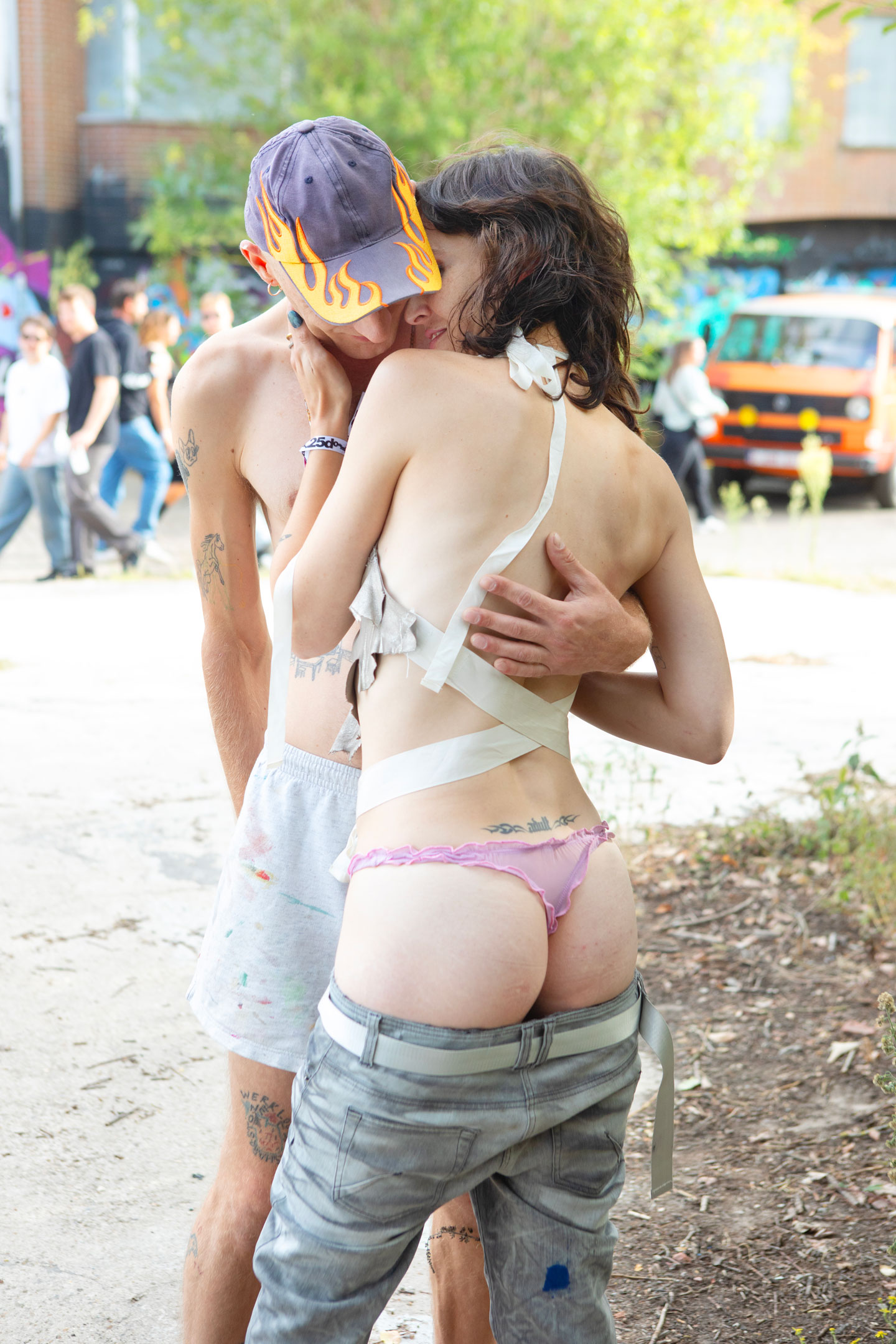
In the work of artist and photographer Lara Verheijden, nudity is a common element. The way Verheijden presents nudity is not intended to attract extra attention or to shock, it serves as the starting point for a conversation between the model and the photographer about comfort, consent, boldness, sexuality, and gender. Her shoots, always set in (semi-)public spaces, become performances. The model remains in control. The resulting portraits are both realistic and staged, with models, or characters, displaying a hormonal and media-savvy self-awareness, deeply influenced by the online world. Decisions about how the images are handled and where they are shown, are always made together.

For Doel Festival, Lara issued an open call for models who then entered into a dialogue with her during and at the festival.

Dauntless Circus is carried by its participating artists Alexandre Bavard, Fleur De Roeck, Ayrton Eblé, Joost Pauwaert and Lara Verheijden.

Dauntless Circus is curated by Benny Van den Meulengracht-Vrancx in assignment of Doel Festival and De Overgang VZW.

Dauntless Circus is made possible by the players of the Nationale Loterij, the support of TICK TACK and DMW Gallery.

All circus photography is taken from the archives of Huis van Alijn, documenting the Belgian circus in the previous century.